 Recent waves of protests in the US have given us useful examples to understand how American revolutionaries can work out our politics in practice. IWW members and branches in particular have witnessed renewed interest and potential in class conflicts, organizing, and aspects of its politics. At the same time, IWWs face a renovated reformist opposition whose tactics and ideas, while not identical, look more and more similar to our own, and pose a challenge for how we can demonstrate concrete solutions to daily issues under capitalism while building a movement against exploitation itself. The declining standard of living, sky rocketing inequality, and grim outlook for workers (if not nearly everyone) presents a challenge and open field for revolutionaries like the IWW who want to organize around the total experience of life under capitalism towards a new society.
In 2011 in Madison, Wisconsin protests and an occupation of the capital erupted in response to a bill banning public sector collective bargaining.[1] Beginning as a defense of established union practice, the protests quickly escalated beyond that and spread calls for direct action, a general strike, and forms of participatory democracy.[2] The Occupy movement, Walmart protests, and retail sector organizing like SEIU’s Fight for 15 similarly adopted a direct action approach. In all of these instances – Madison, Occupy, FF15, etc. – we had a situation where there was some kind of social base for the mass practice of libertarian revolutionary’s tactical and administrative perspectives – direct action, democracy, and confrontation – within a formation where the predominant big picture political perspective was not that of many radicals but rather was one of a more equal, softer capitalism. We can call these movements militant reformism[3], which in the context of the global fiscal crisis aimed (and still aim) at mobilizing the population behind social reforms to improve and save capitalism.
In each case it was tied to a specific class fraction or set of class fractions. These events tapped into but did not articulate, clarify, or advance more fundamental dissatisfaction with the system as a whole. Radicals did little about that, neither putting forward ideas to become more fundamental in its criticisms or more expansive in terms of what class fractions were involved. This is because libertarian revolutionaries have focused too much on those tactical and administrative aspects – basically formal qualities of struggles – and less on actually advancing the ideas they hold among people who don’t already hold those ideas and don’t speak the in-group vocabularies of the libertarian left. The libertarian left in practice has largely put forth/advocated and sought to practice militancy and democracy, and has done much less to convincingly advocate its social vision. This is part of why we were left flat-footed when social movements and NGOs etc., largely adopted similar stances regarding militant and democratic behavior.
 State intervention and mobilizing for reform increasingly is attracting attention and energy.[4] Navigating that and defining an alternative is a distinctly real and immediate problem for the context we are working within. Taking an active position on the State in a union like the IWW has often been seen as something similar to declaring devotion to the teachings of Marx; an abstract issue that doesn’t matter beyond stating group affiliations with some people over others. This is a mistake however because the State and the politics around how groups like the IWW relate to it have a direct and deep impact on day-to-day organizing decisions, and it’s penetration of our work is likely to become increasingly something we face. The political landscape of today is encountering a stead swell of attempts to channel collective actions like those we advocate within statist projects of improving capitalism and helping it overcome the challenges of the past decades. Madison, Fight for 15, Occupy, and recent socialist electoral campaigns have driven our relationship to the State closer and closer, and have made the methods and spheres of action of the IWW increasingly contested.
For many years the mantra of organizing was direct action, direct democracy, and movement building both by revolutionaries as well as the more militant sections of reformists, unionists, and activists. This was held in contrast (within unions, NGOs, political parties, and independent projects) to ideas promoting strict hierarchies or representation, lobbying and electoral reform, and professional services. While radicals were often the ones calling for direct action, in practice different unformed tendencies existed promoting those tactics and structures, many pro-capitalist. Agnostacism about the State, specifically believing we can ignore it all together and achieve more by avoiding politics, was encouraged by this environment. A philosophy of pure action, uniting organizers to just work on fights and move past the political distractions, was put forward as the antidote for the general passivity and withdrawal of people from politics.
For example, in workplace organizing some call for strikes, democracy, and a working class mobilization against management-labor partnership, political lobbying, and narrowly defending the interests of an individual workplace, company, or industry. These arguments are often made speculatively without much concrete examples or experiences to go off and target people on a general basis. Until recently this occurred with little serious competition for those same positions. It was possible to claim the radical nature of a program of direct action and democracy while there were few public reformist campaigns that contradicted it. In Madison, IWWs and revolutionaries promoted direct action and general strikes with broad support amongst a general climate in favor of expanding action and militancy. That energy was ultimately directed into a defense of traditional union structures and bargaining and electoral efforts, most visibly with the recall of anti-union Republicans. The militancy of liberal politicians and reformists took many by surprise and made maintaining momentum for the IWW’s politics and strategy more difficult. During these events, no serious debate emerged around the State within that struggle beyond the issue of strikes versus winning a more supportive legislature. Looking back, it wasn’t only the recuperative efforts that were destructive to more radical actions, but also the hopes and political organization for the reform of capitalist government that played an important role in disarming more radical perspectives within those events.
Likewise Occupy changed the political terrain of the United States through its challenge to popular discourse, channeling discontent beyond the normal detours the rulers used in previous decades. Populist anger and ideas spread alongside rumblings of more overt anti-capitalist and anti-systemic thinking. In some cities the NGOs were heavily involved in Occupy from early on, but mostly the Democratic Party, unions, and NGOs found themselves on the outside and quickly tried to remedy it. The IWW too had to figure out how to relate to the shifted field. Many people normally alienated by political struggles became interested in revolutionary ideas and ways to address growing social ills spreading in communities. IWWs in cities across the US and Canada were being asked for the how and why of revolution; questions that are not answered exclusively by direct action and democracy.
Discontent with the symbolic nature and isolation of the occupations led to experiments in mobilizing around pressing issues: foreclosures, workplace issues, unemployment, etc. In some cities the forces of recuperation were a part of this grassroots organizing from the outset, however in other places they moved in only after the popular mood was more clear. Huge amounts of money poured in largely from unions like SEIU, but also likely from Democratic Party sources. Rather than opposing horizontal methods, they embraced them and sought to direct them militantly in the service of reforms. Foreclosures, the minimum wage, and jobs were all demands of different work out there which the reformists used to put pressure on lawmakers from the outside in parallel with proposals by the Democrats for institutional reform.
This created a problem for revolutionaries involved in Occupy. With thousands activated by experiences in Occupy, projects began to pop up around the country often using the alliances crafted within Occupy. Different radicals, unions, and NGOs collaborated to organize in the community and improve the conditions of the working class. When Obama called for increasing the minimum wage, months later it would be radicals hitting the streets within SEIU, HERE, and other fronts to build actions to pressure for such increases.
Revolutionaries making the same arguments for their methods (such as militancy, direct action, direct democracy, and base building of social movements), shared that same space increasingly filled by people who wanted to improve capitalism not abolish it, and in fact by the elements within the ruling class in some cases. This became sharper with the emergence of the fast food strikes. Though these strikes often became media circuses with little worker participation, the problem remains. What came to the front with the crisis was the need to be able to concretely place movement to save and improve capitalism versus movement to undo it. Literally people began asking revolutionaries how we can create a new society, while the answer of libertarian tactics alone was becoming shown to be not enough on its own.
In the workers struggle this creates immediate issues. SEIU’s Fight for 15 attempts to organize low wage retail workers using direct action to achieve, primarily, a raise in the minimum wage. Today this campaign has hit some initial road-blocks and worker participation has been more limited than hoped. There is speculation that this is a push that, if it gains momentum, would also seek a legislative route to make traditional contracts and union representation viable. Still the opposite could happen. SEIU, if successful, might pursue a non-contractual direct action approach using militant tactics and building a movement of retail workers. Disbelief that any reformism couldn’t be democratic, militant, etc., is likely to be proven wrong at some point even if we aren’t at that point yet. In the IWW, retail workers have a decade or more of experience collectively using similar tactics and as the rhetoric that SEIU has moved onto. If SEIU’s failures to mobilize workers push it further along militant reformism, our agitation as IWWs within the industry will be weakened if not coupled by something that clearly draws out SEIU’s and capitalism’s limitations. If not by direct action, democracy, and militancy, then what distinguishes our revolutionary syndicalism?
As the global situation changes these questions are likely to persist rather than quiet down, even if the crisis recedes. The old political balance and economy has been disrupted, and something new is possibly emerging. The past two years have shown us a glimpse of reformism that is willing to fight directly and challenge power not only within the normal means of struggles, but also beyond that even testing illegality; something a few of us have called militant reformism.[5] We have little idea where it is headed, but as these shifts are contested (from above and below), it’s likely that there will be militant reform attempts to respond to this for some time.
What becomes clear in seeing militant reformism, like that that emerged around Occupy, is that objectives matter significantly. Struggle has the potential to radicalize people, and that should be one of the most important things we keep in mind, but that shouldn’t obscure the fact that the system is very good at internalizing its opposition and enemies. Militancy in the service of making institutions of capitalism (and particularly the State) better able to respond to pressing issues becomes a force against addressing the long-standing problems we face. Fighting daily issues within capitalism should be connected by revolutionaries to work against the system itself. Societies have an equilibrium of power, a balance of opposition, wrangling by the rulers, and an ability to divert, coopt, and redirect resistance from below. When possible we should become a force against capitalism’s equilibrium, taking additional opportunities to radicalize people in the spaces that open up in the system’s disequilibrium, allowing for new orders to emerge.
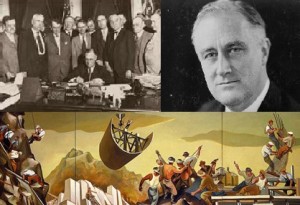 This does not mean that we should support the same work for reforms but advocate mere anti-capitalism. The labor movement of the 1930s often had strong currents with an anti-capitalist orientation, but through its work created new circuits for capitalism in crisis, and a new basis for capitalist expansion. The revolutionaries of the 1930s literally paved the way for world war and the golden era of American capitalism, not it’s defeat. Similarly today many forces are mobilizing for social reforms aimed at creating a new basis for expanded capitalism and directing discontent into transforming the State. It is the role of the State in maintaining order and equilibrium that is central to defeating the total system of exploitation and oppression, and it is exactly the State that reformism tries to redirect popular discontent into in order to save capitalism.
This is why the opposition to the State is a concrete necessity of day-to-day work in organizing rather than merely sectarian or ideological position. The State interferes with collective empowerment not only through corralling activity into elections and lobbying. Society as a whole is tied to the relationships of the State that struggle, contest, and constantly redefine power. Failing to oppose the State directly disarms us against militant reformism often channeling the work of revolutionaries into improving capitalism or making it a mere appendage of populist mobilizations. Recent experiences show the central role of the State in our daily work, and the necessity to concretely oppose it to advance a new social order of solidarity. This is why groups like the IWW, solidarity networks, and other projects that directly oppose the system in daily life need to oppose the State practically, and commit ourselves to organizing against the State. At the same time our weakness on these points was revealed in the lack of concreteness we could put into action. This is a key component of the work of our time; to demonstrate in practice and words clearly how to engage in revolutionary action against the State and Capital.
Practical resistance to the State is invaluable through alternatives to and critiques of electoral routes to social change, institutionalizing struggle (which weakens it and pacifies workers), and the uneven playing field of a State within a hierarchical world of power. We need to become capable of explaining steps people can take in line with our politics towards an alternative society. The critique of statist methods is crucial, but our values, objectives, and the content of our proposal are important factors that help define our revolutionary path. There is not a way to do that without opposing the capitalist State, and doing the necessary work of showing another way.
[1] See (Hawthorne, 2011a).
[2] For an overview, discussion of the IWW’s role, and some critical analysis see (Conatz & Sawyers, 2011), (Conatz, 2011a), and (Conatz, 2011b).
[3] For writings on militant reformism Nate Hawthorne’s work in general is invaluable, however the following pieces are a good start: (Hawthorne, 2012), (Hawthorne, 2011b), and (Nappalos, 2013).
[4] The successful election of Kshama Sawant to Seattle City Council in 2013, and close campaigns of other socialists, only add to this dynamic obviously.
[5] See footnote 3 for citations.
References
Conatz, J., & Sawyers, B. (2011). The General Strike That Didn’t Happen. http://libcom.org/library/general-strike-didnt-happen-report-activity-iww-wisconsin
Conatz, J. (2011a). Why a General Strike Hasn’t Happened Yet. http://libcom.org/blog/some-limitations-movement-wisconsin-04042011
Conatz, J. (2011b). Wisconsin: What now? http://libcom.org/blog/wisconsin-what-now-19062011
Hawthorne, N. (2011a). Struggle Changes People. http://libcom.org/blog/struggle-changes-people-06012012
Hawthorne, N. (2011b). Reform is Possible and Reformism is Guaranteed. http://libcom.org/blog/reform-possible-reformism-guaranteed-22122011
Hawthorne, N. (2012). Occupy vs. Eviction: Radicals, reform, and dispossession. http://libcom.org/blog/occupy-vs-eviction-radicals-reform-dispossession-22062012
Nappalos, S. (2013). Bring Fire to the Castle: Crisis, militant social democracy, insurrection, and existing means of settling disputes. https://snappalos.wordpress.com/2013/01/26/bring-fire-to-the-castle-crisis-militant-social-democracy-insurrection-and-existing-means-of-settling-disputes/
 January 1st is the day of Janus, the Roman god of change, time, and transitions. Janus was a god they did not inherit from the Greeks, and whose origin is mysterious still to this day. The god looks out at the world with two faces, gazing as it were across the world ceasing to be and the world coming into existence. 2016 is a year of yet another presidential election in the United States, but one taking place in an environment of increasing uncertainty about the future for world powers and their subjugated. The last serious presidential contest in 2008 seems worlds away in terms of the context. When youth and the poor mobilized in unprecedented numbers for the Obama campaigns vague promises of change, it would have been hard to imagine that only a few short years later some 40% of the protesters at Occupy had worked for the Democratic Party in their attempt to secure Obama’s victory.


 SN Nappalos